


Honey may look simple at first glance, but there is far more going on than just sweetness. Its taste, aroma, color, and texture all change depending on the plants bees visit, where those plants grow, and the season the honey is harvested.
In this guide, we explore the many types of honey, explain what gives each one its character, and look at how specific plants influence flavor. Along the way, you will see why some honeys are common, others are rare, and how visual cues and texture can hint at what you are about to taste.
By the end, you will have a clearer sense of why one honey feels light and floral while another tastes deep and bold, and how these differences come from nature itself rather than processing.
Does Honey Come in Different Tastes?
Yes, honey comes in many different tastes, and that is completely natural. Even though all honey is sweet, the type of sweetness can change depending on which plants the bees visit.
Every flower produces nectar with its own mix of natural sugars and aroma compounds. When bees spend more time on one type of flower, those characteristics tend to show up in the honey. That is why some honeys taste light and floral, others feel fruity or citrusy, and some come across as deep, earthy, or bold.
One easy way to think about honey flavor is in layers:
-
What you notice first: the main impression, such as floral, fruity, or rich
-
What develops next: softer background notes like citrus, vanilla, herbs, or spice
-
How it finishes: whether the flavor fades quickly or lingers on the palate
Soil conditions, weather patterns, and harvest timing can also influence how honey tastes. Because of this, even the same type of honey can vary slightly from one region to another. In many ways, honey behaves more like coffee or wine than a simple sweetener, carrying subtle clues about where it comes from.
Types of Honey
Honey is not a single, fixed flavor. It changes based on what the bees feed on and what is blooming around them. Broadly, honey falls into two main categories: monofloral honey, which comes mostly from one plant, and polyfloral (wildflower) honey, which comes from many different plant sources.
Monofloral Honey

Monofloral honey is made primarily from one specific plant or flower. While it is never 100 percent pure, because bees will always visit nearby blooms, one dominant plant usually shapes the honey’s overall character. That dominant source is what gives monofloral honey its recognizable flavor, aroma, and appearance.
Because producing monofloral honey depends on a single bloom, careful timing, and the right growing conditions, it is often rarer and more sought after than other types of honey. Limited harvest windows and specific regions can also make it more expensive.
Blossomdale’s Organic Raw Blueberry Honey is a good example of a monofloral honey. It reflects the natural nectar of blueberry blossoms, resulting in gentle berry‑floral notes rather than a generic sweetness.
Monofloral honeys are valued for:
-
Clear, easy-to-recognize flavor profiles
-
Consistent color, aroma, and texture
-
A strong connection to a specific plant source


Polyfloral (Wildflower) Honey

Polyfloral, or wildflower, honey comes from many different plants growing in the same area. Instead of concentrating on one blossom, bees move freely between flowers, herbs, and trees as they forage.
Because of this mixed sourcing, wildflower honey is generally less rare than monofloral honey, but it is still highly popular. Its character can change noticeably depending on the season and the landscape where it is produced.
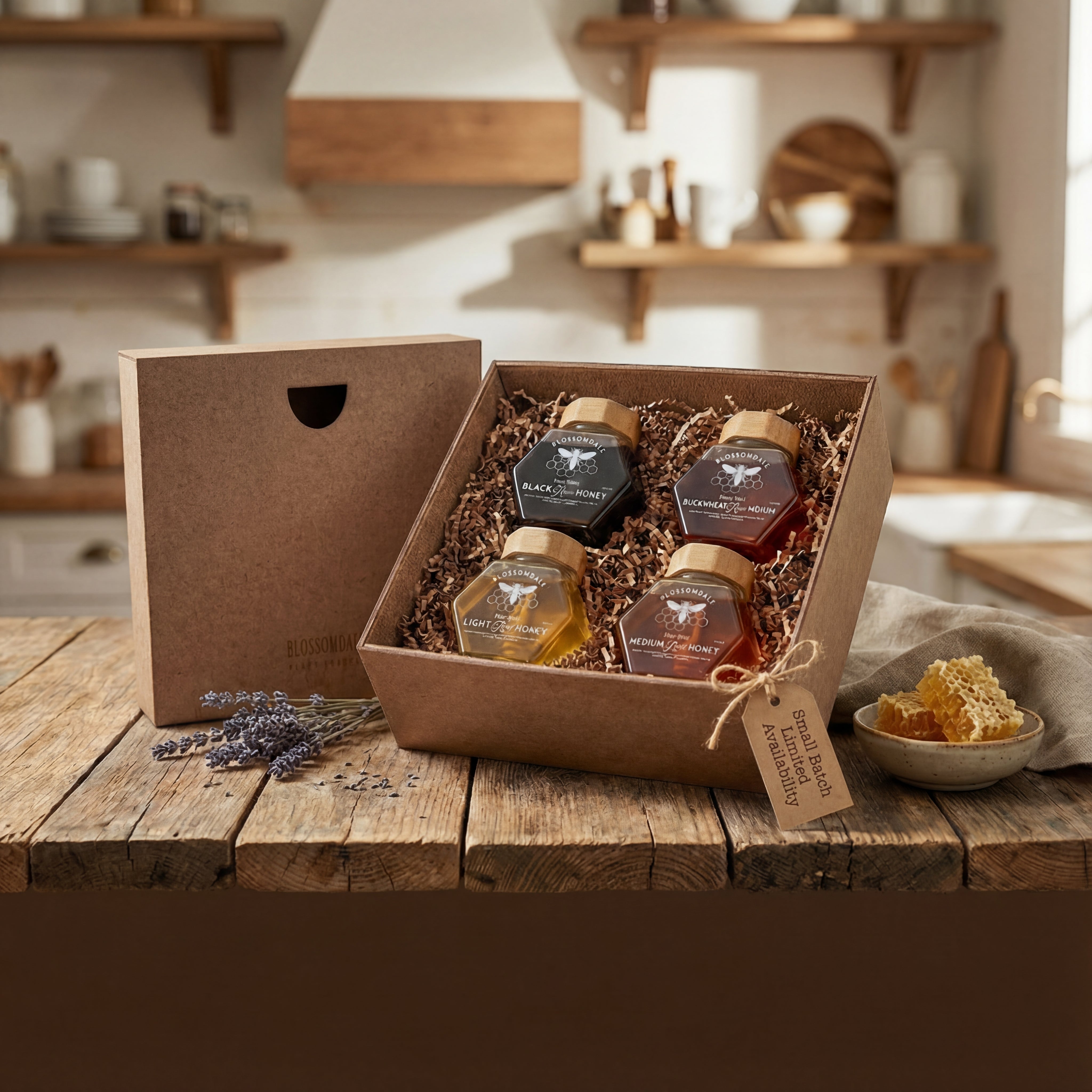
Wildflower honeys are often grouped in two simple ways: by season and by location. For example, late-season or autumn wildflower honeys, such as Blossomdale’s Black Organic Raw Honey, are typically harvested after summer blooms fade. During this time, bees may turn to hardier, late-flowering plants, which can result in a darker color and deeper, earthier flavor compared to spring or summer varieties.
Wildflower honey often reflects:
-
Local plant diversity
-
Seasonal bloom patterns
-
Environmental conditions
While wildflower honey is often more affordable than monofloral honey, certain harvests can still be more expensive due to short bloom periods, specific regions, or limited seasonal availability.
Type of Monofloral Honey
There are many types of monofloral honey, and each one is crafted around a single plant or flower. Because every blossom has its own nectar makeup, each monofloral honey develops a unique flavor, aroma, color, and texture.
Rare Monofloral Honeys
Cherry Blossom Honey


Cherry blossom honey is a rare and delicate monofloral honey known for its refined, elegant character. It is often produced from both ornamental cherry blossoms and fruiting cherry varieties such as Royal Rainier cherry trees and Bing cherry trees. These trees tend to produce nectar with soft floral aromatics and very little bitterness, which helps shape the honey’s gentle profile.
It is best recognized for its light floral sweetness, subtle almond-like notes, and soft, clean finish rather than bold intensity. This honey reflects the gentle nature of cherry blossoms, making it especially appealing to those who prefer mild, nuanced flavors.
Because of its subtle profile, cherry blossom honey is often used as a finishing honey in teas, pastries, light desserts, or drizzled over fresh fruit and yogurt, where it enhances flavor without overpowering it.
How it’s made: Bees collect nectar during the short cherry blossom bloom, which lasts only a few weeks each year.
Where it’s produced: Cherry blossom honey is produced in regions where cherry trees grow in large numbers, especially Japan (including areas such as Nagano and Hokkaido), South Korea (notably mountainous regions with dense cherry blossom growth), and select parts of the United States, particularly Washington and Oregon. Small, limited harvests also come from European cherry-growing regions such as northern Italy, Spain’s Jerte Valley, and parts of Eastern Europe, where production is typically small and seasonal.
Flavor profile:
-
Dominant: Light floral sweetness
-
Secondary notes: Almond, soft fruit, faint vanilla
-
Finish: Clean and delicate, not heavy
Physical characteristics:
-
Color: Very light amber to pale gold
-
Texture: Smooth and fluid, with a light, silky mouthfeel that pours easily and feels clean rather than heavy on the palate
-
Crystallization: Slow
Rarity: High. Short bloom season and limited production make this honey difficult and expensive to obtain.
Apricot Blossom Honey


Apricot blossom honey is also a rare honey and a gently sweet, fruit-forward honey known for its soft and approachable character, often produced from traditional apricot varieties such as Harcot Apricot and Moorpark Apricot trees.
It carries a mild floral sweetness with subtle stone‑fruit notes that echo the aroma of fresh apricots, making it easy to enjoy even for people new to specialty honey.
Its unique identity comes from apricot trees, which produce nectar rich in light fruit sugars and delicate floral compounds. Because of its balanced profile, apricot honey is often used in teas, breakfast foods, baked goods, and light desserts, where it adds sweetness without overpowering other flavors.
How it’s made: Bees forage almost exclusively on apricot blossoms during early spring.
Where it’s produced: Apricot blossom honey is produced in regions with established apricot orchards, particularly Bulgaria and Greece, where traditional apricot cultivation supports small, seasonal blossom honey harvests. Additional production occurs in Turkey (notably the Malatya region), Armenia, and parts of Central Asia, with limited seasonal harvests also found in Italy, Spain, and select areas of the United States, including Oregon and California.
Flavor profile:
-
Dominant: Mild fruity sweetness
-
Secondary notes: Stone fruit, floral nectar
-
Finish: Soft and rounded
Physical characteristics:
-
Color: Light amber
-
Texture: Medium viscosity, meaning it pours steadily without being too thin or too thick, striking a balance between smooth flow and a slightly substantial feel
-
Crystallization: Moderate
Rarity: Moderate to high. Depends on concentrated apricot orchards and timing.
Monofloral Plum Honey

Plum blossom honey is a monofloral honey that has a soft, gentle fruit character that reflects the nectar of plum blossoms, often sourced from select varieties such as Emerald plum trees. It is known for its light sweetness with a subtle tart edge, giving it a slightly brighter profile than many other stone‑fruit honeys.
Its unique identity comes from plum trees, whose blossoms produce nectar with delicate floral aromas and mild natural acidity. Because of this balance, plum honey is often enjoyed in teas, light desserts, yogurt, or simply drizzled over bread, where its flavor adds interest without becoming overpowering.
How it’s made: Nectar collected from plum blossoms in early spring.
Where it’s produced: Plum blossom honey is most commonly produced in Eastern Europe, particularly across the Carpathian region, where plum trees are widely grown and traditional beekeeping is common. Smaller, seasonal harvests are also found in parts of the United States, including California and Hawaii, where plum varieties bloom early and allow short nectar‑collection periods.
Flavor profile:
-
Dominant: Floral sweetness
-
Secondary notes: Light tart fruit, honeyed blossom
-
Finish: Slightly tangy
Physical characteristics:
-
Color: Pale amber
-
Texture: Smooth
-
Crystallization: Medium-fast
Rarity: High due to short bloom windows.
Dandelion Honey
Dandelion honey is monofloral honey with a bold, distinctive flavor made from the nectar of dandelion flowers. Unlike delicate blossom honeys, it is known for its strong personality, offering a deeper, more herbal sweetness that stands out immediately.
Its unique identity comes from dandelion plants themselves, which produce nectar with naturally bitter and green undertones. Because of this, dandelion honey is often used in small amounts in teas, herbal preparations, or as a natural sweetener where a stronger flavor is desired rather than subtle sweetness.
How it’s made: Bees gather nectar from widespread dandelion blooms in spring.
Where it’s produced: Dandelion honey is commonly produced in regions where dandelions grow abundantly in open fields and meadows. In the United States, it is especially associated with the Upper Midwest, including Minnesota, where dandelions bloom heavily in spring. Outside the U.S., dandelion honey is also produced in New Zealand and across parts of Europe, including Italy, Lithuainia, France, the United Kingdom, and Germany, where cool spring climates support strong dandelion nectar flows.
Flavor profile:
-
Dominant: Bold herbal sweetness
-
Secondary notes: Floral bitterness, green notes
Physical characteristics:
-
Color: Bright yellow to golden
-
Texture: Thick, with a dense, slow‑pouring consistency that feels rich and heavy, coating the spoon rather than flowing quickly
-
Crystallization: Fast
Rarity: Moderate. Easy to produce but strong flavor limits popularity.
Acacia Honey
Acacia honey is one of the lightest and most delicate monofloral honeys available, prized for its clean taste and refined simplicity. It is known for its very mild sweetness, subtle floral aroma, and smooth finish, making it especially appealing to those who prefer honey without strong or overpowering flavors.
Its unique identity comes from acacia trees, often referred to as black locust trees, whose nectar is high in fructose and low in bitterness. Because of this composition, acacia honey is commonly used in tea, coffee, dressings, and desserts where a gentle sweetness is desired without altering the original flavor of the food.
How it’s made: Nectar collected from acacia (black locust) trees.
Where it’s produced: Acacia honey is most famously produced in Central and Eastern Europe, particularly Hungary, which is considered one of the world’s leading sources due to its large black locust forests. It is also produced in Italy, especially in northern regions where acacia trees bloom in spring. In the United States, acacia honey comes primarily from the Appalachian region, where black locust trees grow naturally and provide short but concentrated nectar flows.
Flavor profile:
-
Dominant: Clean, mild sweetness
-
Secondary notes: Vanilla, light floral
Physical characteristics:
-
Color: Almost clear
-
Texture: Very fluid
-
Crystallization: Very slow
Rarity: Moderate, highly valued.
Buckwheat Honey
Monofloral buckwheat honey is one of the darkest and most intense honeys available, known for its bold, robust character. Unlike light floral honeys, it delivers a deep, rich sweetness that many people compare to molasses or malt, making it a favorite among those who enjoy strong, full-bodied flavors.
Its unique identity comes from buckwheat plants, which produce nectar high in minerals and complex sugars. Because of its strength, buckwheat honey is often used in baking, marinades, sauces, and as a natural sweetener where a pronounced honey flavor is desired rather than subtle sweetness.
How it’s made: Bees forage on buckwheat blossoms.
Where it’s produced: Buckwheat honey is produced in regions where buckwheat is widely cultivated as a grain crop. In the United States, this includes the Midwest and parts of the Northeast, where buckwheat is grown seasonally. It is also produced across Canada, particularly in agricultural regions with cool summers. In Europe, notable sources include France (especially the Limousin region), Germany, Italy, and parts of Eastern Europe, while Russia remains one of the largest producers due to extensive buckwheat farming. Smaller but established production also exists in parts of China, where buckwheat is traditionally cultivated in higher‑altitude regions.
Flavor profile:
-
Dominant: Strong, molasses-like
-
Secondary notes: Malt, earth, spice
Physical characteristics:
-
Color: Dark brown
-
Texture: Thick
-
Crystallization: Slow
Rarity: Moderate.
Poison Oak Honey
Poison oak honey is an uncommon monofloral honey that often surprises people by its name alone. Despite coming from poison oak plants, the honey itself is completely safe to consume and does not carry the plant’s toxic properties. Instead, it is known for its mild, balanced sweetness and understated character.
Its unique identity comes from poison oak shrubs, which produce nectar with soft floral and subtle woody notes. Because of its gentle profile, poison oak honey is typically used as an everyday table honey, in teas, or as a light drizzle over simple foods where a neutral but distinctive sweetness is appreciated.
How it’s made: Bees collect nectar from poison oak flowers (safe for humans).
Where it’s produced: Poison oak honey is produced in select parts of the U.S. West Coast, primarily in California and Oregon, where poison oak grows naturally in woodland areas, coastal ranges, and foothills. Production is highly localized and seasonal, depending on the presence of flowering poison oak and controlled hive placement.
Flavor profile:
-
Dominant: Mild floral
-
Secondary notes: Herbal, woody
Physical characteristics:
-
Color: Amber
-
Texture: Medium
Rarity: High due to limited regions.
Common Monofloral Honeys
Clover Honey
Clover honey is one of the most widely recognized and commonly consumed monofloral honeys. It is known for its mild, clean sweetness and neutral flavor, which makes it a familiar and approachable option for everyday use.
Its unique identity comes from clover plants, which produce nectar that results in a smooth, balanced honey without strong floral or fruity notes. Because of its gentle profile, clover honey is often used as a general-purpose sweetener in tea, coffee, baking, and table use.
Where produced: Clover honey is widely produced in regions where clover grows naturally in open fields and pastures. In the United States and Canada, it is commonly harvested across agricultural areas with large grazing lands, especially in the Midwest and Prairie regions. New Zealand is also a major producer, where clover-rich pastures support consistent, large-scale honey production.
Flavor profile:
-
Dominant: Mild, classic sweetness
Physical characteristics:
-
Color: Light amber
-
Texture: Smooth and medium-bodied, flowing easily without being too thin or overly thick
Rarity: Very common
Apple Blossom Honey


Apple blossom honey is a lightly sweet, floral-fruity honey that reflects the delicate nectar of apple tree blossoms. It is known for its gentle sweetness with a soft fruity note and a faint tart edge, giving it a fresh and clean character.
Its unique identity comes from apple trees—often including well-known orchard varieties such as Jonagold, Pink Lady, and Honeycrisp—whose blossoms produce nectar with subtle fruit acids and floral aromas. Because of this balanced profile, apple blossom honey is often used in teas, light baking, salad dressings, or drizzled over yogurt and fresh fruit, where it adds sweetness without overpowering other flavors.
Where produced: Apple blossom honey is produced in regions with extensive apple orchards. In the United States, this includes states such as Washington, New York, Michigan, and parts of Pennsylvania, where apple farming is widespread. In Europe, it is commonly produced in countries with strong apple-growing traditions, including France, Germany, Italy, and Eastern European regions, where spring apple blossoms provide short but concentrated nectar flows.
Flavor profile:
-
Dominant: Fruity, floral
-
Secondary notes: Light tartness
Physical characteristics:
-
Color: Light amber
-
Texture: Smooth and light-bodied, flowing easily without feeling heavy
-
Crystallization: Moderate, forming fine crystals gradually over time
Rarity: Common
Raspberry Blossom Honey
Raspberry blossom honey is a lightly sweet, aromatic honey with a soft berry and floral character. It has a gentle sweetness with subtle fruit notes, which makes it feel brighter and more fragrant than many everyday table honeys.
This honey gets its personality from raspberry plants, whose blossoms produce nectar with delicate berry undertones and light floral aromatics. The result is a balanced, pleasant honey that feels easy to enjoy without being overpowering. It is commonly used in teas, desserts, breakfast foods, or simply drizzled over yogurt or toast.
Where produced: Raspberry blossom honey is most often produced in the Pacific Northwest of the United States, including Washington, Oregon, and parts of Idaho, where raspberry farms and wild brambles bloom heavily in spring and early summer. In Europe, it is produced in regions with established raspberry cultivation, particularly Eastern Europe, Scandinavia, and parts of Germany and Poland.
Blueberry Blossom Honey
Blueberry blossom honey is a lightly sweet monofloral honey known for its gentle floral character and subtle berry influence. Rather than tasting like blueberries themselves, it offers a soft, clean sweetness with delicate fruit and floral notes.
Its character comes from blueberry plants, often including cultivated varieties such as Pink Icing Blueberry and Jelly Bean Blueberry. These blossoms tend to produce nectar with mild aromatics instead of strong fruit sugars, which gives the honey its smooth, restrained profile. Because of this, blueberry blossom honey works especially well in teas, oatmeal, yogurt, or as a light finishing drizzle.
Where produced: Blueberry blossom honey is most strongly associated with Maine in the United States, where vast wild and cultivated blueberry fields bloom in late spring and early summer. It is also produced across Canada, particularly in Quebec, Nova Scotia, and British Columbia, where blueberry farming and wild growth support reliable seasonal nectar flows.
Flavor profile:
-
Dominant: Mild floral sweetness
-
Secondary notes: Subtle berry notes
Physical characteristics:
-
Color: Light amber
-
Texture: Smooth and fluid
-
Crystallization: Slow
Rarity: Common
Orange Blossom Honey
Orange blossom honey is a fragrant, aromatic monofloral honey best known for its bright citrus and floral character. It offers a smooth sweetness with fresh orange blossom notes that feel both floral and lightly citrusy, making it one of the most recognizable honeys by aroma alone.
This honey comes from citrus trees, primarily orange trees, whose blossoms produce nectar rich in natural citrus aromatics. Because of its lively yet balanced flavor, orange blossom honey is often used in teas, desserts, baked goods, marinades, and as a finishing drizzle where a touch of fragrance can lift the overall dish.
Where produced: Orange blossom honey is produced in regions with extensive citrus groves. In the United States, this includes Florida, especially central and southern areas, and California, particularly citrus-growing regions in the Central Valley and Southern California. Outside the U.S., Spain is a major producer, notably in Valencia and Andalusia, where long citrus flowering seasons support consistent nectar flows.
Flavor profile:
-
Dominant: Floral citrus sweetness
-
Secondary notes: Fresh orange zest
Physical characteristics:
-
Color: Pale gold
-
Texture: Smooth and medium-bodied
-
Crystallization: Moderate
Rarity: Common
Alfalfa Honey
Alfalfa honey is a mild, easy drinking monofloral honey known for its clean sweetness and neutral character. It is often described as smooth and gentle, which makes it one of the most approachable honeys for everyday use.
Its flavor comes from alfalfa plants, whose nectar produces a light, uncomplicated sweetness without strong floral or fruity notes. Because it stays out of the way flavor-wise, alfalfa honey is commonly used as a general sweetener in tea, coffee, baking, and cooking when sweetness is needed without changing the overall taste of the dish.
Where produced: Alfalfa honey is primarily produced in the Western United States, where alfalfa is widely grown as an agricultural crop. Key producing states include California, Idaho, Montana, Utah, and parts of the Great Plains, where large alfalfa fields provide steady nectar flows during late spring and summer.
Flavor profile:
-
Dominant: Mild sweetness
-
Secondary notes: Light herbal notes
Physical characteristics:
-
Color: Extra light amber
-
Texture: Smooth and light-bodied
-
Crystallization: Moderate
Rarity: Common
Types of Wildflower Honey
Wildflower honey is made when bees gather nectar from many different plants growing in the same area. Instead of reflecting one specific blossom, it captures whatever is blooming nearby at that moment. Because of this, wildflower honey can vary widely in flavor, color, and intensity, even when it comes from the same region.
By Season
Looking at wildflower honey by season helps explain why some jars taste light and delicate while others feel bold and full. As the year progresses, different plants come into bloom, and bees naturally work with what is available at that time.
Spring Wildflower:
Spring wildflower honey is often the first honey harvested after winter. It reflects the earliest blooms of the year, when plants begin flowering quickly as temperatures rise and bees return to active foraging.
-
Possible influences: May include clover, dandelion, fruit blossoms such as apple, cherry, and apricot, along with other early wildflowers
-
Flavor: Light, fresh, and floral, with a clean sweetness that feels gentle on the palate
-
Aroma: Soft florals with subtle green or grassy notes
-
Color: Pale amber to light gold
-
Texture: Smooth and fluid
Spring wildflower honey is well suited for people who enjoy mild flavors. It is often used in tea, drizzled over fruit, or enjoyed as an everyday table honey.
Summer Wildflower:
Summer wildflower honey develops when plant diversity is at its highest. With many flowers, herbs, and wild plants in bloom, bees collect nectar from a wide range of sources, which adds depth and character to the honey.
-
Possible influences: May include herbs, berries, wildflowers, and flowering shrubs
-
Flavor: Richer and more layered, sometimes showing fruity, herbal, or lightly spicy notes
-
Aroma: Fuller and more aromatic than spring varieties
-
Color: Golden to medium amber
-
Texture: Medium-bodied and slightly thicker than spring honey
Because of its balance and depth, summer wildflower honey is especially versatile. It works well in cooking and baking and pairs nicely with foods like yogurt, cheese, and warm breads.
Autumn Wildflower:
Autumn wildflower honey is harvested later in the year, after many delicate blooms have faded. At this point, bees often turn to hardier, late-flowering plants that produce darker, more concentrated nectar.
-
Possible influences: May include goldenrod, aster, and other late-season wild plants
-
Flavor: Deeper and more robust, with earthy notes that may feel slightly herbal or malty
-
Aroma: Warm and full
-
Color: Dark amber to brown
-
Texture: Thicker and denser, with a tendency to crystallize more quickly
Autumn wildflower honey appeals to those who enjoy stronger flavors. It is commonly used in baking, marinades, or anywhere a more pronounced honey taste is welcome.
By Area
When wildflower honey is grouped by area, the focus shifts to the landscape surrounding the hive. Geography plays a quiet but important role in shaping which plants grow nearby, and that, in turn, influences a honey’s flavor, aroma, and overall intensity. Even during the same season, honey can taste noticeably different depending on whether it comes from open plains, higher elevations, or fertile valleys.
Prairie Wildflower:
Prairie wildflower honey comes from wide, open landscapes where bees may forage across grasses, clover, sunflowers, and other low growing flowering plants common to plains and grassland regions.
-
Possible plant influences: May include grasses, clover, sunflowers, and native prairie blooms
-
Flavor: Typically balanced and mildly sweet, with a clean, straightforward character rather than bold intensity
-
Aroma: Light floral notes with gentle grassy or hay-like hints
-
Color: Often light amber to golden, though this can shift depending on rainfall and bloom density
-
Texture: Smooth and medium-bodied, flowing easily without feeling thin
-
Crystallization: Moderate, often forming fine crystals over time
Because prairie landscapes tend to be relatively uniform, the resulting honey often has a consistent and approachable flavor. This makes prairie wildflower honey easy to enjoy as an everyday option, whether stirred into tea or used as a simple table honey.
Mountain Wildflower:
Mountain wildflower honey is shaped by higher elevations, cooler temperatures, and shorter blooming periods. Bees may gather nectar from a wide range of alpine flowers and herbs that grow in rugged, less predictable terrain.
-
Possible plant influences: May include alpine wildflowers, herbs, and high elevation flowering plants
-
Flavor: Often more layered and complex, with herbal, mineral, or lightly resinous notes
-
Aroma: More pronounced and aromatic, sometimes with fresh or pine-like qualities
-
Color: Ranges from golden to darker amber, depending on altitude and available blooms
-
Texture: Medium to thick, sometimes slightly denser due to higher mineral content
-
Crystallization: Variable and sometimes uneven because of diverse nectar sources
Mountain environments, including thinner air, rocky soil, and frequent temperature changes, can affect how nectar develops. Over time, these conditions often contribute to honey with greater depth and a more distinctive personality.
Valley Wildflower:
Valley wildflower honey comes from fertile lowland areas where bees may forage among fruit trees, flowering weeds, and a mix of agricultural and natural plant life.
-
Possible plant influences: May include fruit blossoms, wild weeds, and mixed flowering plants
-
Flavor: Commonly floral and lightly fruity, with soft sweetness and gentle fruit-forward notes
-
Aroma: Light and fragrant, sometimes carrying fresh or juicy impressions
-
Color: Light to medium amber
-
Texture: Smooth and often slightly fluid
-
Crystallization: Moderate, influenced by the balance of fruit blossom nectar
Valley regions tend to support abundant and diverse plant growth. This variety often results in honey that feels rounded, pleasant, and versatile.
Wrap Up!
Honey is best understood as a reflection of place, season, and the plants surrounding the hive, not as a single, uniform product. Every jar tells a slightly different story shaped by nectar sources, weather, soil, and harvest timing. These factors can influence flavor, aroma, color, texture, and consistency in ways that range from subtle to bold.
By learning about different types of honey, from monofloral varieties to seasonal and regional wildflower honeys, it becomes easier to understand why no two honeys are ever exactly the same. Exploring honey is less about chasing rarity and more about paying attention to how bees, plants, and landscape work together to create flavors that feel natural, distinctive, and deeply tied to where they come from.