
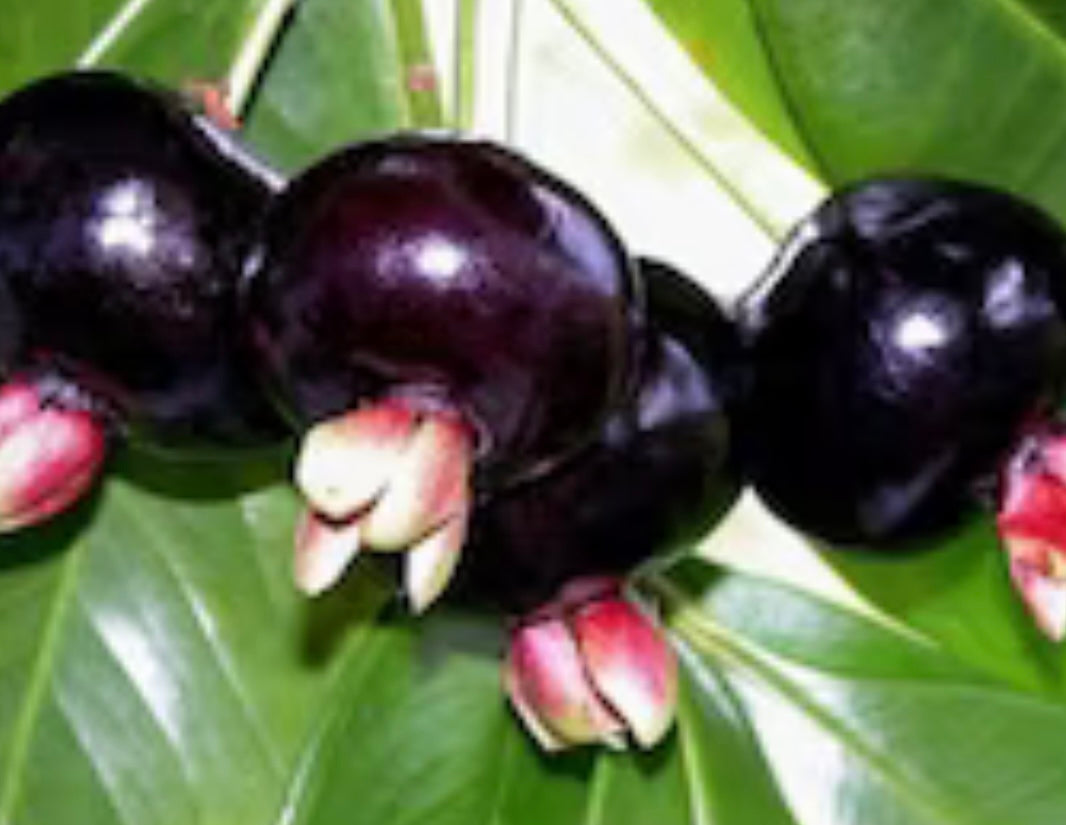
A tropical evergreen fruit tree with glossy dark-green leaves, small white flowers, and deep purple, cherry-like fruit — ornamental beauty paired with an edible harvest.
The Brazilian Grumichama cherry tree (Eugenia brasiliensis) is a tropical evergreen fruit tree that often catches a gardener's eye the first time they see it. The tree carries glossy dark-green leaves, small white flowers, and deep purple fruit that looks surprisingly similar to cherries. Despite the name, the fruit is not related to the cherries commonly grown in temperate climates. It belongs to the Myrtaceae family, which includes guava, jaboticaba, and many other tropical fruit species.
Native to Brazil's Atlantic rainforest, the Grumichama tree has gradually found its way into tropical gardens and rare fruit collections around the world. Many home growers appreciate it because it combines ornamental beauty with edible harvests. The fruit has a pleasant flavor, and the tree generally stays manageable in size, especially with light pruning. For gardeners interested in unusual fruit trees, Grumichama offers something a little different from the typical backyard orchard.
01What Is the Brazilian Grumichama Cherry Tree?
The Brazilian Grumichama cherry tree (Eugenia brasiliensis) is an evergreen fruit tree that belongs to the Myrtaceae plant family. This group includes well-known tropical fruit trees such as guava and jaboticaba. Although the fruit resembles cherries in appearance, it is not related to true cherries from the Prunus genus.
The tree produces round berries that ripen to deep red, purple, or nearly black. The fruit contains soft, juicy flesh and typically one or two seeds, though some berries may contain up to three. In its natural habitat, the tree grows within Brazil's Atlantic coastal forest and often forms part of the forest understory.
Outside its native range, the tree is commonly grown as a backyard fruit tree or ornamental landscape plant. Its compact growth and attractive foliage make it suitable for residential gardens.
Where does the Grumichama tree naturally grow?
Grumichama trees originate in Brazil's Atlantic rainforest, particularly in coastal regions that extend from Bahia to Santa Catarina. These forests provide warm temperatures, moderate rainfall, and humid air that suit the tree well.
Over time, the species has been introduced to several other warm regions. Today it is cultivated in Florida, Hawaii, parts of Australia, Southeast Asia, Central America, and the Caribbean. In these climates, the tree adapts well to home gardens and small orchards.
Because it tolerates partial shade and a range of well-drained soils, the Grumichama tree is considered relatively adaptable in tropical landscapes.
How big does a Grumichama cherry tree grow?
In natural rainforest conditions, Grumichama trees can grow between 20 and 30 feet tall. In home gardens, however, they usually remain smaller.
Many gardeners maintain trees at around 10 to 15 feet through occasional pruning. This size allows easier harvesting and helps the tree fit comfortably into residential landscapes.
The canopy tends to develop a rounded shape with dense, glossy foliage. With regular pruning, the tree can also be shaped into a hedge or compact ornamental tree.
What does Grumichama fruit taste like?
Grumichama fruit has a sweet flavor balanced by mild acidity. Many people describe the taste as similar to cherries or grapes, sometimes with subtle plum-like notes.
The flesh is soft and juicy, and the thin skin can be eaten along with the fruit. Because the berries bruise easily, they are usually enjoyed soon after picking.
Among tropical Eugenia fruits, Grumichama is often considered one of the more pleasant flavors, which contributes to its growing popularity among fruit collectors.
Are Grumichama and Surinam cherries the same fruit?
Grumichama and Surinam cherry are related plants but are different species. Grumichama is Eugenia brasiliensis, while Surinam cherry is Eugenia uniflora.
The fruits look noticeably different. Grumichama berries are smooth and round, while Surinam cherries have a ribbed shape that resembles a small pumpkin.
The flavor also differs. Surinam cherries can have a strong resin-like taste that some people find overpowering. Grumichama fruit tends to be sweeter and milder, which is why many gardeners prefer growing it.
02Growing and Caring for a Grumichama Cherry Tree
Gardeners interested in planting Grumichama often want to understand how easy it is to grow. In suitable climates, the tree is generally considered low maintenance once established.
How do you grow a Grumichama cherry tree?
Grumichama trees grow best in warm climates with well-drained soil and regular moisture. They prefer full sun but can also tolerate partial shade, particularly in hot regions.
Young trees benefit from consistent watering while their roots establish. Adding mulch around the base of the tree helps retain moisture and protect the soil.
Once established, the tree becomes moderately tolerant of short dry periods. With basic care, it can grow steadily and produce fruit each year.
How long does it take for a Grumichama tree to produce fruit?
Trees grown from seed usually begin producing fruit after about four to five years. Trees propagated from cuttings or grafted nursery plants may begin fruiting slightly earlier.
One interesting feature of the species is the short period between flowering and fruit maturity. After the tree blooms, the berries often ripen within three to five weeks.
In warm climates, mature trees can produce consistent harvests every year.
Can Grumichama trees grow in pots or small gardens?
Grumichama trees can adapt well to container growing, which makes them suitable for patios or small gardens.
A large container with good drainage is important for healthy growth. Gardeners often use a potting mix that includes organic matter to support the plant.
Regular watering and occasional fertilization help maintain strong growth. Pruning allows the tree to remain compact while still producing fruit.
Do Grumichama trees need more than one tree to produce fruit?
Grumichama trees are self-fertile. This means a single tree can produce fruit without another tree nearby.
Pollinators such as bees still help improve fruit set, and gardens with active pollinator populations may see better yields.
Some growers plant more than one tree to increase production, though it is not necessary for fruiting.
What climate does the Grumichama cherry tree prefer?
The Grumichama cherry tree grows best in tropical and subtropical climates with warm temperatures throughout the year.
Established trees can tolerate brief exposure to light frost, sometimes down to around 28°F (−2°C). Young trees are more sensitive to cold conditions and may need protection during cold spells.
Regions with warm summers and mild winters generally provide the best conditions for healthy growth and fruit production.
03Harvesting and Using Grumichama Fruit
Once the tree begins producing fruit, gardeners often want to know when to harvest the berries and how they can be used.
When does Grumichama fruit ripen?
Grumichama fruit develops quickly after the tree flowers. In many cases, the berries ripen within three to five weeks.
In tropical climates, harvest season typically occurs between late spring and early summer, though the timing can vary depending on local weather conditions.
Because the fruit ripens quickly, gardeners often monitor the tree closely during this period.
How do you know when Grumichama fruit is ready to harvest?
Ripe Grumichama fruit turns deep purple or almost black and becomes slightly soft to the touch. The berries also develop a mild sweet scent when fully mature.
At this stage, the fruit can be gently picked from the tree. Because the skin is thin, careful handling helps prevent bruising.
Many growers prefer harvesting fruit early in the morning when temperatures are cooler.
What can you do with Grumichama cherries?
Grumichama fruit is most often eaten fresh shortly after harvesting. The sweet flavor and juicy texture make it enjoyable straight from the tree.
When trees produce larger harvests, the fruit is commonly used for jams, jellies, sauces, and desserts. Some people also blend the berries into juices or smoothies.
Because the fruit softens quickly, it is usually prepared or eaten soon after picking.
Are Grumichama cherries healthy?
Grumichama fruit contains vitamin C and other natural compounds commonly found in dark-colored fruits. Like many berries, it also provides fiber, natural sugars, and hydration.
While the fruit has not been studied as extensively as some commercial berries, its nutritional profile is comparable to many tropical fruits.
Fresh fruit offers a simple way to enjoy homegrown produce.
Why do gardeners plant Grumichama trees in home orchards?
Gardeners often plant Grumichama trees because they combine ornamental beauty with edible fruit production. The glossy leaves and small white flowers make the tree attractive even when it is not fruiting.
The fruit itself adds to the appeal. Because it rarely appears in grocery stores, harvesting it at home feels like discovering a fruit that many people have never tasted.
For gardeners interested in unusual fruit trees or edible landscaping, the Brazilian Grumichama cherry tree can be a rewarding addition to the garden.
Currently Out of Stock
Grumichama is a rare find and not available right now — but our collection has plenty of other unique, garden-ready fruit trees worth a look.
Browse Available Plants